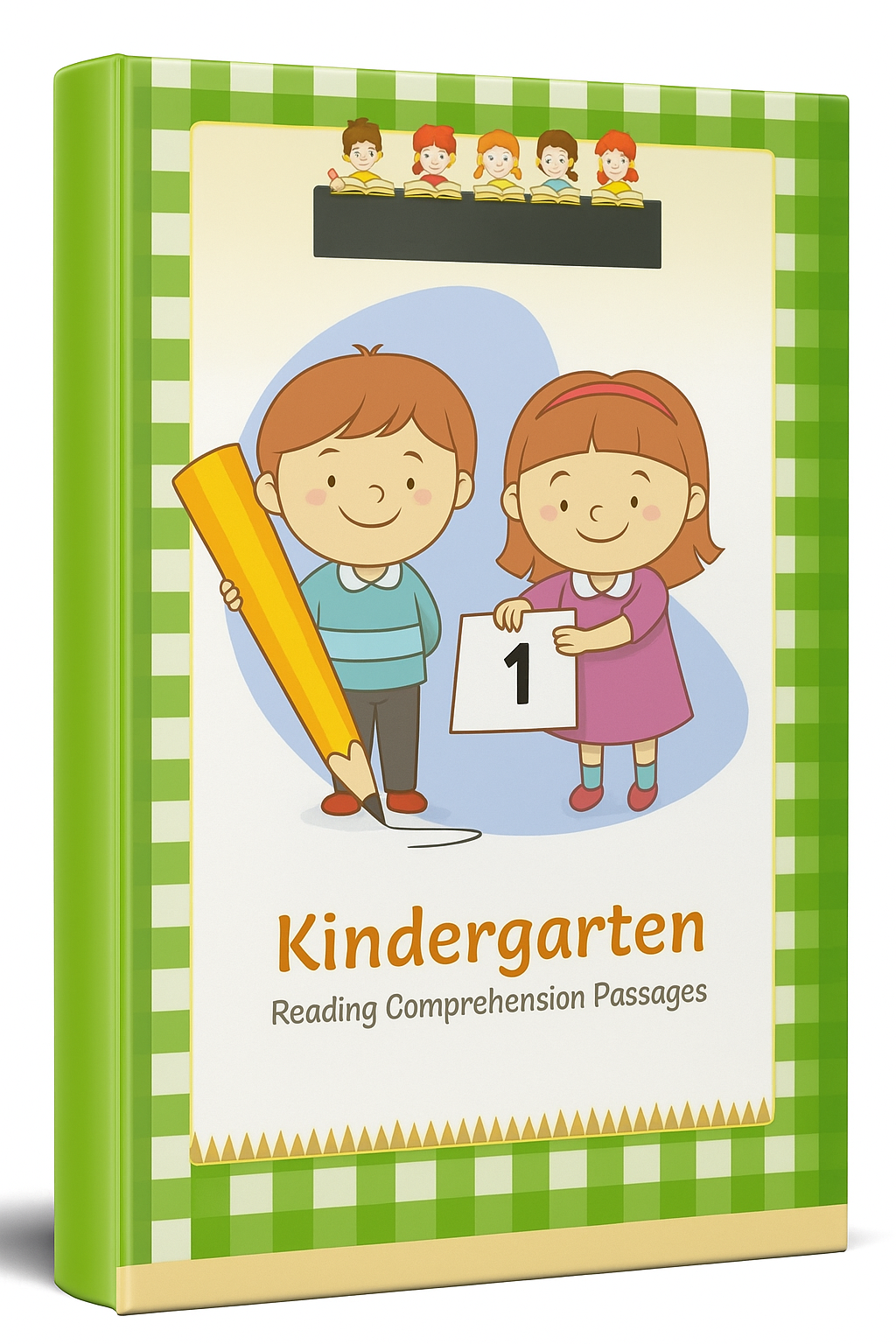
Kindergarten Easy Reading Comprehension Passages

Kindergarten Easy Reading Comprehension Passages gives the youngest readers their first real reading work: short, friendly passages written for kindergarten eyes, each followed by simple questions that prove — to the child most of all — that the words were understood.

Comprehension is the point of reading, and it starts earlier than most people think. A five-year-old who can answer “who?” and “what happened?” about a tiny text is doing the same act a university student does with a novel — at kindergarten scale, with kindergarten joy.

It is made for kindergarten children (ages 4–6), their teachers, and parents building the reading habit at home.

Kindergarten Easy Reading Comprehension Passages
These passages are engineered for the exact moment a child crosses from decoding to reading. Each text is short — a few lines about the things kindergarten children know and love: pets and playgrounds, families and food, weather, seasons and small adventures — written with controlled, mostly decodable vocabulary and generous repetition, so success is built in. After each passage come the questions, and their design is the pedagogy: picture-friendly prompts and simple who/what/where questions first, then the first steps of thinking — why did it happen, what might come next — answered by pointing, circling, drawing or a spoken sentence before writing is demanded. For teachers, the set is a complete comprehension station: printable, levelled by feel rather than by label, usable for guided reading, morning work, homework and the assessment evidence early-years records require. Parents get the home version of the same gift — a passage a night, two questions over cocoa, and a child who discovers that books answer back. The skills are the foundations everything later stands on: recall, sequence, prediction, and the habit of expecting text to make sense.

About This Book

This is a set of easy reading comprehension passages for kindergarten: short controlled-vocabulary texts about familiar everyday topics, each with simple questions — recall, sequence and first prediction — for readers aged about 4 to 6.

What Young Readers Will Do

Read Tiny Texts That Make Sense

Short passages about pets, family, play, food and seasons — written with decodable, repeated vocabulary so a beginning reader finishes every one successfully.

Answer Real Questions

Who, what and where questions first, then why and what-next — comprehension practised at speaking level before writing level, with picture-friendly response formats.

Build the Reading Habit

One passage at a time, reread with pride: fluency, confidence and the expectation that print means something — the three foundations of every later reader.

Key Features

The controlled vocabulary is the feature — success is engineered, not hoped for. The question design is the second: comprehension from the very first year of reading, in formats small children can actually answer. The print-and-go format is the third, for classrooms and kitchens alike.

Who This Book Is For

It is for kindergarten and early-years teachers, parents and homeschoolers of 4–6-year-olds, reading intervention and ESL teachers of young beginners, and tutors building first comprehension skills.

How to Use This Book

Read the passage aloud together first, then let the child read it — echo and choral reading are bridges, not cheating. Ask the questions conversationally before any are written; oral answers are real comprehension. Reread favourites across the week: the second and third readings are where fluency visibly grows.

Related Books

A first classic novel for growing readers is To kill a Mockingbird. School English for the next stage is Oxford Progressive English Grade 7.

Download More pdf Files

Scroll to Top